Safety Helmet Mold: Engineering Lightweight Solutions for E-Mobility & Consumer Markets
The global e-mobility revolution has created an explosive new market for head protection. With electric bicycle sales exceeding 40 million units annually and mandatory helmet laws expanding across Europe, Asia, and North America, safety helmet mold demand has shifted from industrial PPE toward consumer-oriented designs prioritizing weight reduction, ventilation, and aesthetic appeal.
Table of Contents
ToggleThis transformation requires Industrial safety helmet molds engineering that balances crash protection with the comfort expectations of everyday riders.
The E-Mobility Helmet Market Dynamics
- Weight targets: Sub-300g designs for urban commuter helmets, compared to 400g+ industrial models
Ventilation density: 14-18 integrated air channels maintaining airflow during low-speed riding
Multi-impact durability: In-mold construction fusing polycarbonate shells with EPS foam liners for repeated protection
- Aesthetic integration: Gloss/matte surface finishes, customizable color systems, and integrated LED mounting points
In-Mold Construction: The Consumer Standard
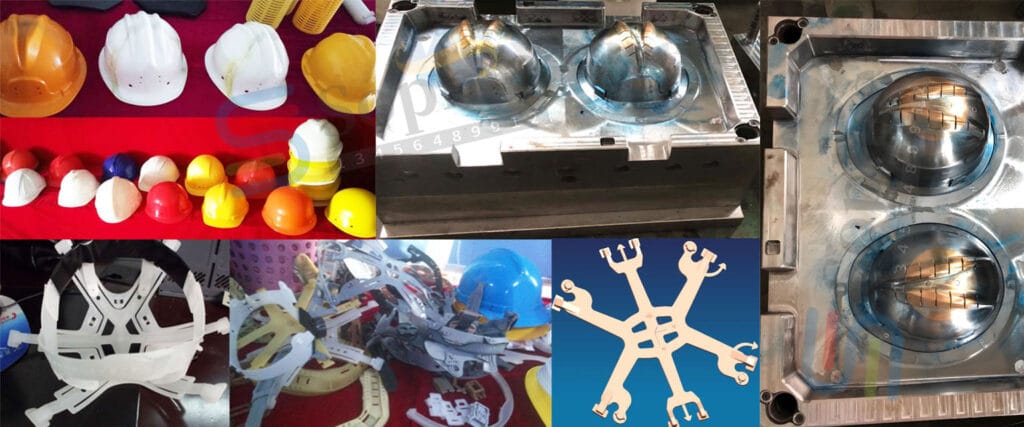
Shell Formation: Ultra-thin polycarbonate (PC) outer layers, typically 0.8-1.2mm thick, are vacuum-formed or injection-molded as pre-forms. These shells require precision molds with high-gloss cavity finishes (SPI-A2) achieving optical clarity for premium aesthetic appeal.
EPS Integration: Expanded polystyrene foam liners are injection-molded directly into the PC shell, creating permanent chemical bonding. This eliminates the weight of separate adhesive layers while improving impact energy distribution across the helmet surface.
Material Selection for Weight Optimization
| Component | Material | Weight Impact | Mold Requirement |
|---|---|---|---|
| Outer shell | PC (polycarbonate) | 80-120g total | High-gloss polish, 280-320°C processing |
| Impact liner | EPS (expanded polystyrene) | 100-150g total | Steam chest molding or in-mold integration |
| Retention system | PP (polypropylene) | 30-50g total | Standard injection, living hinge compatibility |
| Comfort pads | TPE (thermoplastic elastomer) | 20-30g total | Overmolding capability, soft-touch surfaces |
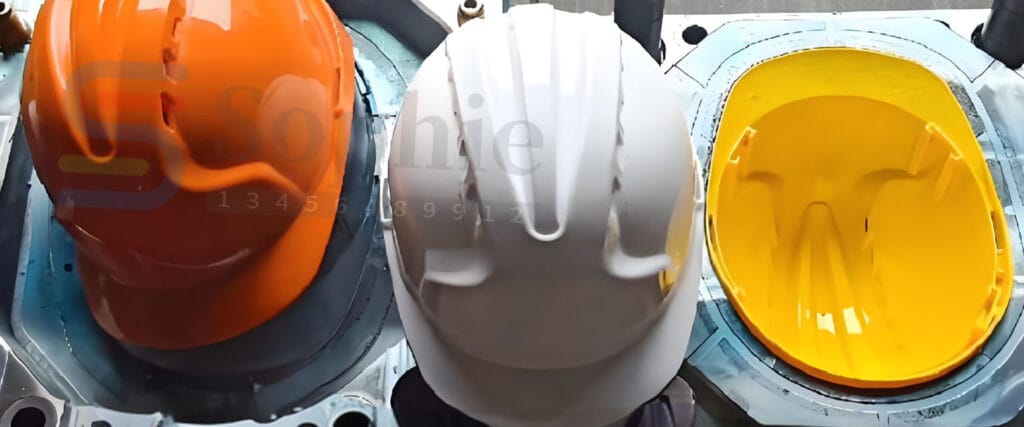
Safety Helmet Mold Design for Consumer Comfort Features
Production Efficiency for High-Volume Markets
| Production Scale | Cavitation | Cycle Time | Annual Output |
|---|---|---|---|
| Startup/validation | 1-cavity | 45-60 seconds | 50,000 units |
| Medium volume | 2-cavity | 35-45 seconds | 150,000 units |
| High volume | 4-cavity | 25-35 seconds | 400,000+ units |
Sustainability and Circular Economy
- Recycled PC content: Post-consumer water bottle material integrated into shell production, requiring mold vent modifications for degraded flow properties
- Bio-based EPS: Plant-derived polystyrene alternatives with comparable impact absorption but modified steam chest molding parameters
- Modular designs: Molded-in standardized mounting systems enabling component replacement rather than complete helmet disposal