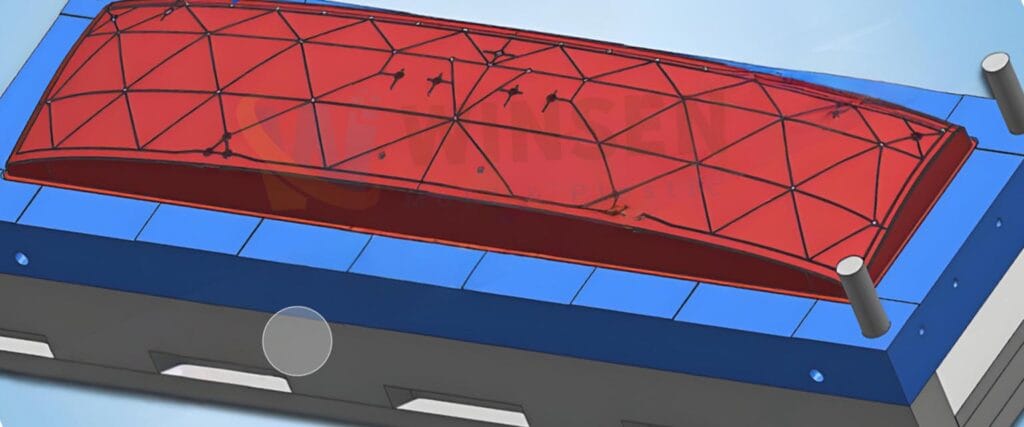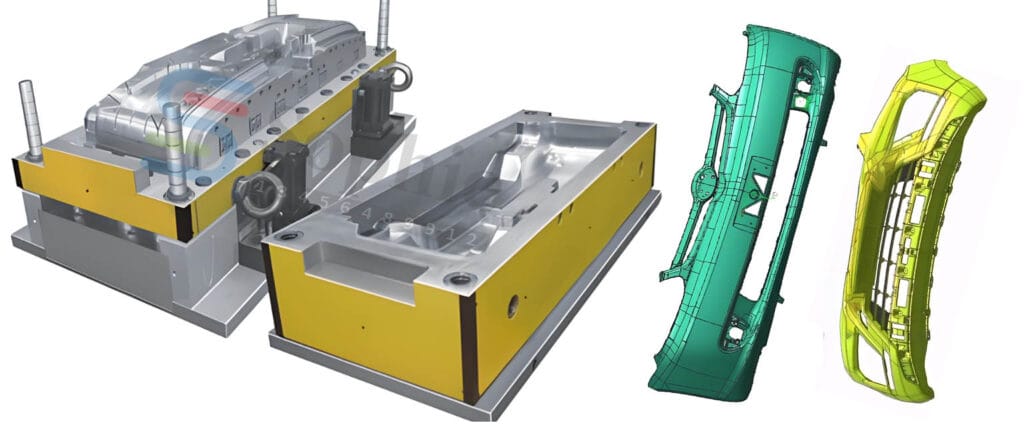
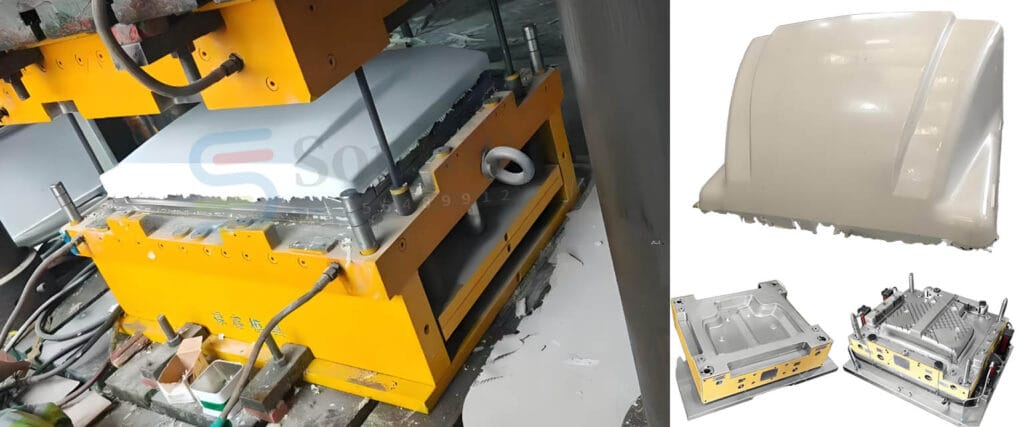
SMC Mould: Engineering Precision for Sheet Molding Compound Compression
SMC Material Composition and Molding Dynamics
SMC consists of chopped glass fibers (10-60% by weight), unsaturated polyester or vinyl ester resin, mineral fillers, catalysts, and thickeners sandwiched between carrier films.
Table of Contents
ToggleUnlike thermoplastic injection, SMC compression involves irreversible chemical cross-linking—requiring SMC mould designs that manage exothermic reaction heat while maintaining dimensional stability.
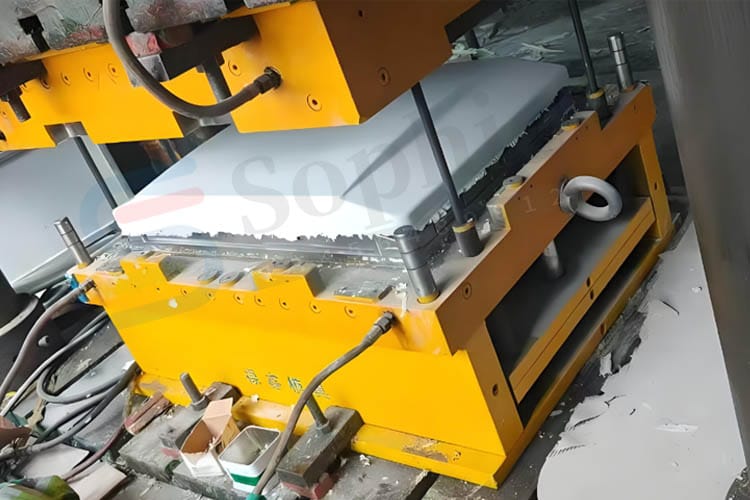
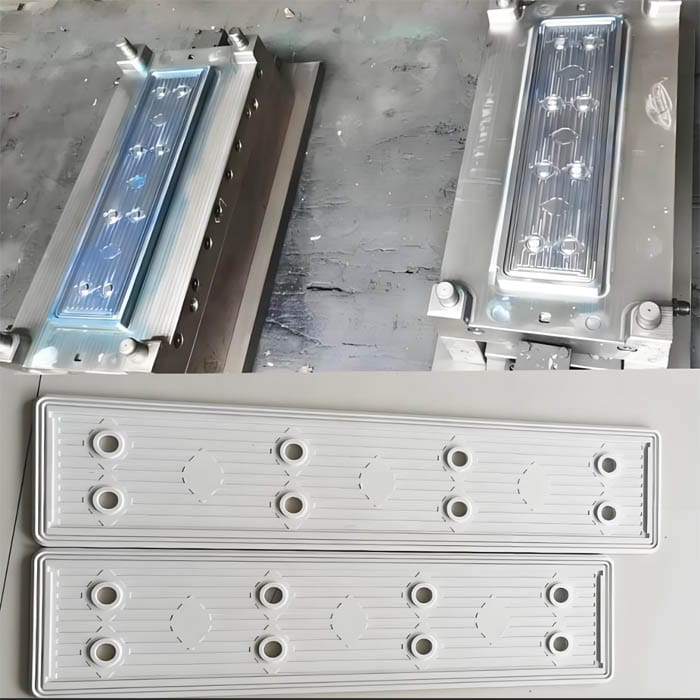
Critical Process Parameters for SMC Mould Operation
| Parameter | Typical Range | Engineering Impact |
|---|---|---|
| Mold Temperature | 135–170°C | Controls curing rate, flow distance, and surface finish |
| Molding Pressure | 7–20 MPa (1,000–3,000 psi) | Ensures fiber wet-out, density, and dimensional accuracy |
| Cycle Time | 30 seconds–5 minutes | Depends on part thickness and cure system speed |
SMC Mould Structural Design Essentials
Heating System Architecture
- Thermal oil circulation: Superior temperature uniformity for large automotive panels
- Cartridge heating: Modular flexibility for complex geometries
- Steam systems: Cost-effective for high-volume commodity production
- Electric heating: Precise zone control for multi-cavity tools
Steel Selection and Heat Treatment
| Application | Steel Grade | Hardness | Rationale |
|---|---|---|---|
| Low-volume, large parts | P20 | HRC 28–34 | Pre-hardened, no post-heat treatment, cost efficiency |
| High-volume automotive | H13 | HRC 48–52 | Thermal fatigue resistance, 500,000+ shot durability |
| Corrosive environments | S136 | HRC 48–52 | Stainless properties for PVC or aggressive resins |

Shear Edge and Parting Line Engineering
Advanced SMC Mould Features
- Vacuum channels integrated into cavity and core
- Sealing systems maintaining vacuum integrity during press motion
- Pressure sensors monitoring mold atmosphere in real-time.
Ejection and Handling Systems
Quality Validation Protocols
- Dimensional CMM verification: Ensuring ±0.1mm tolerance on critical mating surfaces
- Thermal imaging: Confirming uniform heating across cavity surfaces
- Pressure mapping: Validating consistent clamp force distribution
- Cycle time optimization: Balancing cure completion with production throughput
Economic Considerations and Tooling Strategy
- Extended tool life (300,000 vs. 1,000,000+ shots)
- Reduced maintenance intervals
- Consistent dimensional stability preventing scrap
Conclusion
The SMC mould represents a critical intersection of thermal engineering, materials science, and precision manufacturing. Success requires understanding the unique demands of thermoset compression: active heating rather than cooling, chemical shrinkage compensation, and fiber-flow management. By investing in appropriate steel grades, optimized heating systems, and vacuum-assisted molding technology, manufacturers can deliver composite components that outperform metals in weight, corrosion resistance, and design freedom.
Ready to develop precision SMC moulds for your automotive or industrial composite program? Contact our engineering team for thermal analysis, DFM consultation, and custom compression tooling solutions tailored to your production volume and quality requirements.